 Add to Chrome
 Add to Firefox
 Add to Edge
SetCon: Towards Open-Ended Referring Segmentation via Set-Level Concept Prediction
May 19, 2026
Referring segmentation grounds natural-language queries to pixel-level masks, but extending it to complex scenarios with multiple instances, cross-category groups, or open-ended target sets remains challenging. Previous Large Vision Language Model (LVLM)-based methods represent referred targets with one or more special tokens sequentially, treating multiple targets as separate outputs rather than a coherent set and offering little incentive to capture set-level properties such as completeness and mutual exclusivity. We reformulate open-ended referring segmentation as explicit set-level concept prediction and propose Set-Concept Segmentation (SetCon), which uses LVLM-generated natural-language concepts, instead of segmentation-specific tokens, as semantic conditions for joint mask-set decoding. A hierarchical semantic decomposition first predicts a shared set-level concept defining the target scope and then refines it into fine-grained concept groups aligned with target subsets. To support this, a two-stage annotation pipeline augments existing reasoning segmentation datasets with hierarchical semantic supervision (236k samples, 784k concept phrases). SetCon achieves state-of-the-art results on image benchmarks (+3.3 gIoU on gRefCOCO, +12.1 gIoU on MUSE), with margins that grow as the number of referred targets increases. The concept interface also transfers to video under a detect-and-track setting, yielding new state-of-the-art results on seven referring video benchmarks, including +10.9 J&F on MeViS and +12.4 J&F on Ref-SeCVOS.

Achieving Gold-Medal-Level Olympiad Reasoning via Simple and Unified Scaling
May 13, 2026Recent progress in reasoning models has substantially advanced long-horizon mathematical and scientific problem solving, with several systems now reaching gold-medal-level performance on International Mathematical Olympiad (IMO) and International Physics Olympiad (IPhO) problems. In this paper, we introduce a simple and unified recipe for converting a post-trained reasoning backbone into a rigorous olympiad-level solver. The recipe first uses a reverse-perplexity curriculum for SFT to instill rigorous proof-search and self-checking behaviors, then scales these behaviors through a two-stage RL pipeline that progresses from RL with verifiable rewards to more delicate proof-level RL, and finally boosts solving performance with test-time scaling. Applying this recipe, we train a 30B-A3B backbone with SFT on around 340K sub-8K-token trajectories followed by 200 RL steps. The resulting model, SU-01, supports stable reasoning on difficult problems with trajectories exceeding 100K tokens, while achieving gold-medal-level performance on mathematical and physical olympiad competitions, including IMO 2025/USAMO 2026 and IPhO 2024/2025. It also demonstrates strong generalization of scientific reasoning to domains beyond mathematics and physics.
OMIBench: Benchmarking Olympiad-Level Multi-Image Reasoning in Large Vision-Language Model
Apr 22, 2026Large vision-language models (LVLMs) have made substantial advances in reasoning tasks at the Olympiad level. Nevertheless, current Olympiad-level multimodal reasoning benchmarks for these models often emphasize single-image analysis and fail to exploit contextual information across multiple images. We present OMIBench, a benchmark designed to evaluate Olympiad-level reasoning when the required evidence is distributed over multiple images. It contains problems from biology, chemistry, mathematics, and physics Olympiads, together with manually annotated rationales and evaluation protocols for both exact and semantic answer matching. Across extensive experiments on OMIBench, we observe meaningful performance gaps in existing models. Even the strongest LVLMs, such as Gemini-3-Pro, attain only about 50% on the benchmark. These results position OMIBench as a focused resources for studying and improving multi-image reasoning in LVLMs.
P1-VL: Bridging Visual Perception and Scientific Reasoning in Physics Olympiads
Feb 10, 2026The transition from symbolic manipulation to science-grade reasoning represents a pivotal frontier for Large Language Models (LLMs), with physics serving as the critical test anchor for binding abstract logic to physical reality. Physics demands that a model maintain physical consistency with the laws governing the universe, a task that fundamentally requires multimodal perception to ground abstract logic in reality. At the Olympiad level, diagrams are often constitutive rather than illustrative, containing essential constraints, such as boundary conditions and spatial symmetries, that are absent from the text. To bridge this visual-logical gap, we introduce P1-VL, a family of open-source vision-language models engineered for advanced scientific reasoning. Our method harmonizes Curriculum Reinforcement Learning, which employs progressive difficulty expansion to stabilize post-training, with Agentic Augmentation, enabling iterative self-verification at inference. Evaluated on HiPhO, a rigorous benchmark of 13 exams from 2024-2025, our flagship P1-VL-235B-A22B becomes the first open-source Vision-Language Model (VLM) to secure 12 gold medals and achieves the state-of-the-art performance in the open-source models. Our agent-augmented system achieves the No.2 overall rank globally, trailing only Gemini-3-Pro. Beyond physics, P1-VL demonstrates remarkable scientific reasoning capacity and generalizability, establishing significant leads over base models in STEM benchmarks. By open-sourcing P1-VL, we provide a foundational step toward general-purpose physical intelligence to better align visual perceptions with abstract physical laws for machine scientific discovery.
EchoReview: Learning Peer Review from the Echoes of Scientific Citations
Jan 31, 2026As the volume of scientific submissions continues to grow rapidly, traditional peer review systems are facing unprecedented scalability pressures, highlighting the urgent need for automated reviewing methods that are both scalable and reliable. Existing supervised fine-tuning approaches based on real review data are fundamentally constrained by single-source of data as well as the inherent subjectivity and inconsistency of human reviews, limiting their ability to support high-quality automated reviewers. To address these issues, we propose EchoReview, a citation-context-driven data synthesis framework that systematically mines implicit collective evaluative signals from academic citations and transforms scientific community's long-term judgments into structured review-style data. Based on this pipeline, we construct EchoReview-16K, the first large-scale, cross-conference, and cross-year citation-driven review dataset, and train an automated reviewer, EchoReviewer-7B. Experimental results demonstrate that EchoReviewer-7B can achieve significant and stable improvements on core review dimensions such as evidence support and review comprehensiveness, validating citation context as a robust and effective data paradigm for reliable automated peer review.
P1: Mastering Physics Olympiads with Reinforcement Learning
Nov 17, 2025Recent progress in large language models (LLMs) has moved the frontier from puzzle-solving to science-grade reasoning-the kind needed to tackle problems whose answers must stand against nature, not merely fit a rubric. Physics is the sharpest test of this shift, which binds symbols to reality in a fundamental way, serving as the cornerstone of most modern technologies. In this work, we manage to advance physics research by developing large language models with exceptional physics reasoning capabilities, especially excel at solving Olympiad-level physics problems. We introduce P1, a family of open-source physics reasoning models trained entirely through reinforcement learning (RL). Among them, P1-235B-A22B is the first open-source model with Gold-medal performance at the latest International Physics Olympiad (IPhO 2025), and wins 12 gold medals out of 13 international/regional physics competitions in 2024/2025. P1-30B-A3B also surpasses almost all other open-source models on IPhO 2025, getting a silver medal. Further equipped with an agentic framework PhysicsMinions, P1-235B-A22B+PhysicsMinions achieves overall No.1 on IPhO 2025, and obtains the highest average score over the 13 physics competitions. Besides physics, P1 models also present great performance on other reasoning tasks like math and coding, showing the great generalibility of P1 series.
Discrete Diffusion VLA: Bringing Discrete Diffusion to Action Decoding in Vision-Language-Action Policies
Aug 27, 2025Vision-Language-Action (VLA) models adapt large vision-language backbones to map images and instructions to robot actions. However, prevailing VLA decoders either generate actions autoregressively in a fixed left-to-right order or attach continuous diffusion or flow matching heads outside the backbone, demanding specialized training and iterative sampling that hinder a unified, scalable architecture. We present Discrete Diffusion VLA, a single-transformer policy that models discretized action chunks with discrete diffusion and is trained with the same cross-entropy objective as the VLM backbone. The design retains diffusion's progressive refinement paradigm while remaining natively compatible with the discrete token interface of VLMs. Our method achieves an adaptive decoding order that resolves easy action elements before harder ones and uses secondary remasking to revisit uncertain predictions across refinement rounds, which improves consistency and enables robust error correction. This unified decoder preserves pretrained vision language priors, supports parallel decoding, breaks the autoregressive bottleneck, and reduces the number of function evaluations. Discrete Diffusion VLA achieves 96.3% avg. SR on LIBERO, 71.2% visual matching on SimplerEnv Fractal and 49.3% overall on SimplerEnv Bridge, improving over both autoregressive and continuous diffusion baselines. These findings indicate that discrete-diffusion action decoder supports precise action modeling and consistent training, laying groundwork for scaling VLA to larger models and datasets.
ARC-Hunyuan-Video-7B: Structured Video Comprehension of Real-World Shorts
Jul 28, 2025Real-world user-generated short videos, especially those distributed on platforms such as WeChat Channel and TikTok, dominate the mobile internet. However, current large multimodal models lack essential temporally-structured, detailed, and in-depth video comprehension capabilities, which are the cornerstone of effective video search and recommendation, as well as emerging video applications. Understanding real-world shorts is actually challenging due to their complex visual elements, high information density in both visuals and audio, and fast pacing that focuses on emotional expression and viewpoint delivery. This requires advanced reasoning to effectively integrate multimodal information, including visual, audio, and text. In this work, we introduce ARC-Hunyuan-Video, a multimodal model that processes visual, audio, and textual signals from raw video inputs end-to-end for structured comprehension. The model is capable of multi-granularity timestamped video captioning and summarization, open-ended video question answering, temporal video grounding, and video reasoning. Leveraging high-quality data from an automated annotation pipeline, our compact 7B-parameter model is trained through a comprehensive regimen: pre-training, instruction fine-tuning, cold start, reinforcement learning (RL) post-training, and final instruction fine-tuning. Quantitative evaluations on our introduced benchmark ShortVid-Bench and qualitative comparisons demonstrate its strong performance in real-world video comprehension, and it supports zero-shot or fine-tuning with a few samples for diverse downstream applications. The real-world production deployment of our model has yielded tangible and measurable improvements in user engagement and satisfaction, a success supported by its remarkable efficiency, with stress tests indicating an inference time of just 10 seconds for a one-minute video on H20 GPU.
Aligning Latent Spaces with Flow Priors
Jun 05, 2025This paper presents a novel framework for aligning learnable latent spaces to arbitrary target distributions by leveraging flow-based generative models as priors. Our method first pretrains a flow model on the target features to capture the underlying distribution. This fixed flow model subsequently regularizes the latent space via an alignment loss, which reformulates the flow matching objective to treat the latents as optimization targets. We formally prove that minimizing this alignment loss establishes a computationally tractable surrogate objective for maximizing a variational lower bound on the log-likelihood of latents under the target distribution. Notably, the proposed method eliminates computationally expensive likelihood evaluations and avoids ODE solving during optimization. As a proof of concept, we demonstrate in a controlled setting that the alignment loss landscape closely approximates the negative log-likelihood of the target distribution. We further validate the effectiveness of our approach through large-scale image generation experiments on ImageNet with diverse target distributions, accompanied by detailed discussions and ablation studies. With both theoretical and empirical validation, our framework paves a new way for latent space alignment.
Beamforming Design for Beyond Diagonal RIS-Aided Cell-Free Massive MIMO Systems
Mar 10, 2025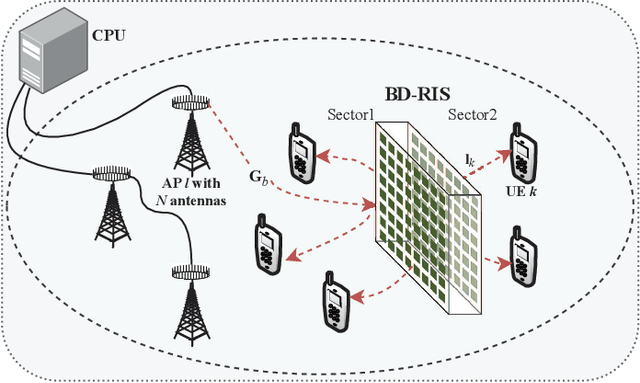
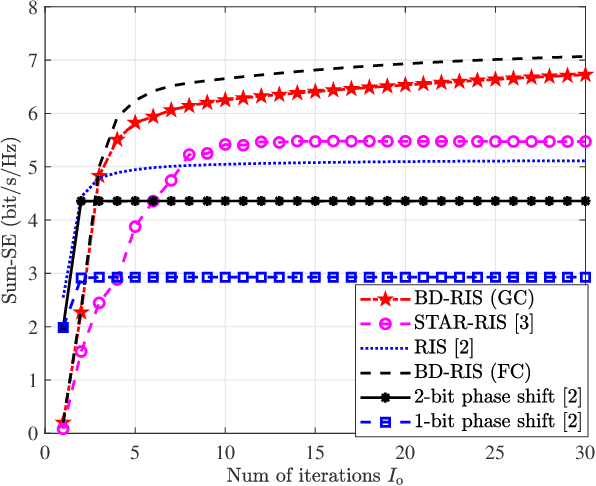
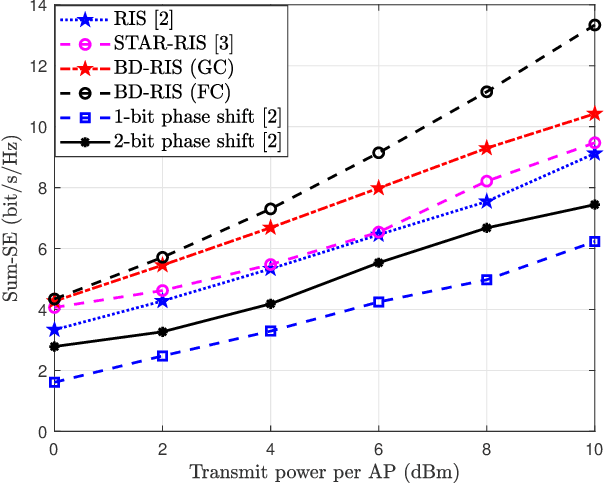
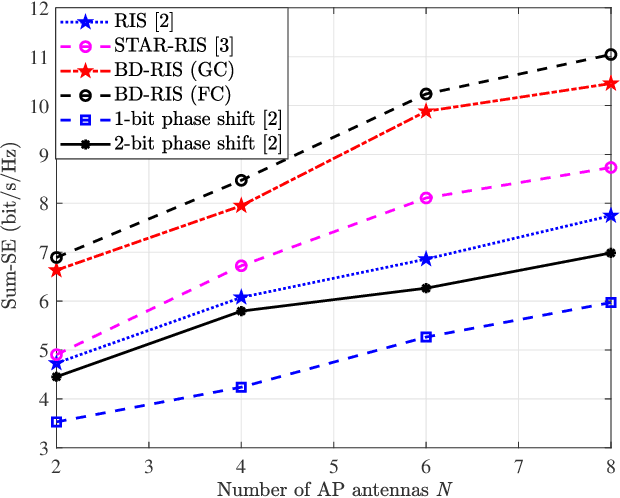
Reconfigurable intelligent surface (RIS)-aided cell-free (CF) massive multiple-input multiple-output (mMIMO) is a promising architecture for further improving spectral efficiency (SE) with low cost and power consumption. However, conventional RIS has inevitable limitations due to its capability of only reflecting signals. In contrast, beyond-diagonal RIS (BD-RIS), with its ability to both reflect and transmit signals, has gained great attention. This correspondence focuses on using BD-RIS to improve the sum SE of CF mMIMO systems. This requires completing the beamforming design under the transmit power constraints and unitary constraints of the BD-RIS, by optimizing active and passive beamformer simultaneously. To tackle this issue, we introduce an alternating optimization algorithm that decomposes it using fractional programming and solves the subproblems alternatively. Moreover, to address the challenge introduced by the unitary constraint on the beamforming matrix of the BD-RIS, a manifold optimization algorithm is proposed to solve the problem optimally. Simulation results show that BD-RISs outperform RISs comprehensively, especially in the case of the full connected architecture which achieves the best performance, enhancing the sum SE by around 40% compared to ideal RISs.